Diploma in Homeopathic Practice
Curriculum Overview
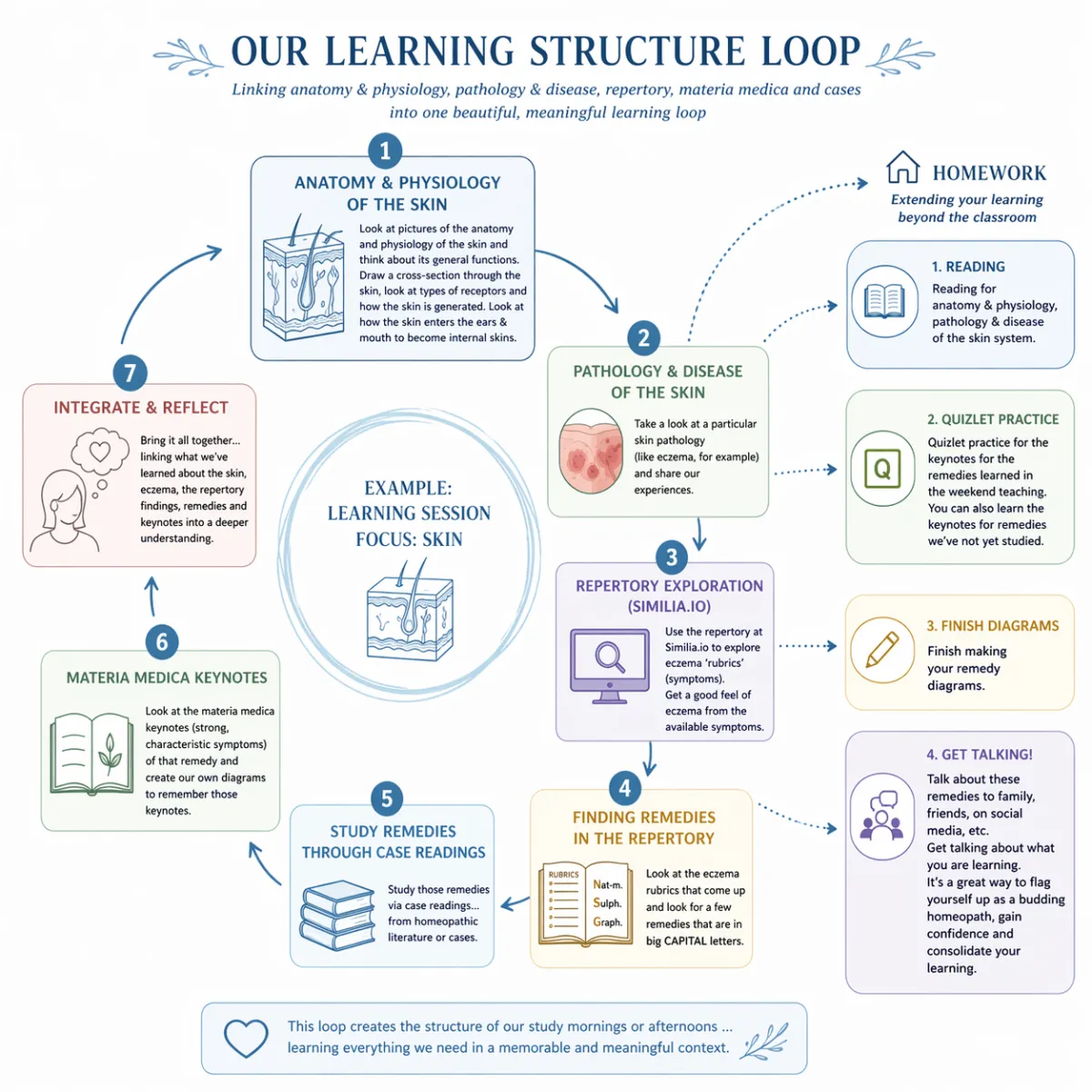
Novel, memorable learning structures
Learning at ISHP is integrated, practical and centred around real patients. Rather than studying subjects in isolation, students explore anatomy, physiology, pathology, repertory, materia medica and philosophy together through carefully designed learning loops. Each topic builds on what students already know, is immediately applied in context, and is revisited throughout the diploma with increasing depth and clinical complexity.
Curriculum Overview
Diploma in Homeopathic Practice
Our Educational Philosophy
At Inspire School of Homeopathic Practice (ISHP), we believe that the best practitioners are not created through memorising disconnected facts, but by learning to see the patient as a whole.
Rather than teaching anatomy, pathology, materia medica, repertory and philosophy as isolated subjects, we integrate them through real clinical situations. Every topic builds upon what students already know, creating an increasingly connected understanding of health, disease and healing.
Students revisit core concepts throughout the three years, each time with greater depth, broader clinical experience and increasing confidence. This spiral approach allows knowledge to become practical wisdom rather than information that is quickly forgotten.
Learning is always embedded in context, immediately connected to real patients and applied in practice.
How You'll Learn
Each study weekend follows the same integrated learning journey.
~ Saturday Morning
Build the foundations by exploring anatomy, physiology, pathology and the body's normal function before understanding what happens when health begins to decline.
~ Saturday Afternoon
Deepen that understanding by connecting philosophy, clinical reasoning and homeopathic principles to the body systems being studied.
~ Sunday Morning
Explore how those principles appear in real patients through materia medica, repertory work, differential analysis and supervised case discussions.
~ Sunday Afternoon
Apply your learning through live case-taking, clinical supervision, practical demonstrations or guest teaching.
Rather than four separate teaching sessions, each weekend forms one continuous learning experience centred around a single clinical theme.
Year One – Building Strong Foundations
The first year focuses primarily on acute illness, the body's interfaces with the external world, and developing confidence in observation and clinical thinking.
Students study:
Anatomy & Physiology
Pathology
Health and Disease
Homeopathic Philosophy
Organon
Repertory
Materia Medica
Acute Prescribing
Case Analysis
Clinical Observation
Communication Skills
Professional Habits
Looking After Yourself Whilst Studying
Students also begin building their own digital materia medica and learn to use modern homeopathic software as part of everyday study.
Year Two – Developing Clinical Understanding
Year Two moves increasingly into chronic disease while expanding clinical reasoning and confidence.
Students continue developing:
Anatomy & Physiology of the major body systems
Chronic pathology
Differential analysis
Advanced repertory skills
Deeper materia medica
Case analysis
Clinical supervision
Acute clinic experience
Recognising miasmatic patterns
Nosodes and sarcodes
Tautopathy and isopathy
Students take an increasingly active role in supervised clinical work.
Year Three – Becoming a Practitioner
The final year is centred on professional practice and supervised patient care.
Students develop confidence in:
Managing chronic cases
Advanced case analysis
Remedy differentiation
Family and remedy group study
Periodic Table methodology
Doctrine of Signatures
Other contemporary approaches to case analysis
Clinical supervision
Practice management
Professional confidence
By graduation, students will have managed their own supervised cases while developing the confidence, systems and experience needed to continue growing a successful, ethical homeopathic practice.
Health & Disease
This theme is woven throughout the entire diploma.
Students continually explore:
Understanding Health
What health looks like
One body, one disease
Looking beyond diagnoses
What is healthy and what is pathological
What is strange, rare and peculiar
Levels of Health
Prognosis
Terrain
The role of the microbiome
Understanding Disease
Suppression
Trauma
Stress
Environment
Thought
Maintaining causes
Supporting Recovery
Homeopathy
Nutrition
Lifestyle
Environment
Relationships
Understanding the healing process
Recognising returning symptoms and old acute illnesses
Healing reactions and discharges
Red flags requiring referral
Students also learn how to explain these concepts clearly and compassionately to patients, helping them understand both the healing process and their own role within it.
Clinical Learning
Clinical experience is embedded throughout the programme.
Students will:
Observe experienced practitioners
Watch live and recorded consultations
Participate in interactive case analysis
Attend supervised case discussions
Progress into supervised patient care
Complete a minimum of 30 supervised cases before graduation
Clinical confidence develops gradually, with increasing independence throughout the diploma.
Practice & Professional Development
Professional practice is developed alongside clinical training from the very beginning of the diploma. Students gradually build the confidence, skills and systems needed to establish an ethical, sustainable practice before they graduate.
Topics include:
Professional identity
Compassionate communication
Confidentiality and professionalism
Practice management
Building a sustainable practice
Finding your niche
Ethical marketing
Educational content creation
Public speaking
Websites and online presence
Modern technology for homeopaths
AI in homeopathic practice
Online consultations
Automation and digital workflows
Throughout the diploma, students begin building ethical, sustainable practices alongside their clinical training, so that by graduation they are not starting from scratch, but continuing to grow practices they have already begun to establish.
Learning Throughout the Diploma
Some themes are intentionally revisited throughout all three years.
These include:
Clinical reasoning
Health and disease
Ethical practice
Reflective learning
Communication
Case analysis
Professional development
Technology in practice
Red flags and referral
Building practitioner confidence
Each time these themes are revisited they are explored in greater depth and applied within increasingly complex clinical situations.
Our Goal
Our aim is to develop thoughtful, compassionate and confident homeopaths who understand health, think critically and communicate clearly.
Throughout the diploma, students begin building ethical, sustainable practices alongside their clinical training, so that by graduation they are not starting from scratch, but continuing to grow practices they have already begun to establish.
Graduates leave ISHP with clinical experience, practical confidence and a deep understanding of homeopathy, ready to continue developing thriving practices while supporting patients safely, ethically and effectively.
Ongoing Learning, Support & Opportunities
Learning at ISHP extends far beyond the monthly study weekends. Throughout the diploma, students are supported by a vibrant learning community where understanding is deepened, questions are explored and confidence grows alongside teachers and fellow students.
Every Friday at 4:45 pm (UK time), students come together online for a one-hour community session. This is the heartbeat of the diploma, providing a regular opportunity to discuss current learning, ask questions, work through challenges, share insights and support one another as developing practitioners.
During Year One, students also attend a weekly online session every Tuesday at 6:00 pm (UK time). Running until the end of March, these sessions develop an understanding of the Three Principles and explore how this understanding supports both homeopathic practice and family life, helping students cultivate the clarity, resilience and presence needed to care well for themselves and their patients.
From April of Year One, and throughout Years Two and Three, Tuesday evenings are dedicated to small-group case supervision. Students present cases, develop their clinical reasoning and learn together under tutor guidance, with every case becoming a valuable learning opportunity for the whole group.
Each student will also receive at least one individual 30-minute tutorial with Wren each month.
This combination of structured teaching, regular community support, individual tutorials and collaborative case supervision ensures that students are never learning in isolation. Instead, they develop as part of a supportive community, growing in knowledge, confidence and clinical judgement throughout the diploma.
Would you like to find out more?
Speak to Wren one-to-one
If you like the look of the training but just want to ask personal questions and introduce yourself to Wren ... book here.
© Copyright 2026 Inspire School of Homeopathic Practice Ltd | Registered: England, UK. Company number: 17279064
Acceptable Use Policy | Terms Of Website Use | Privacy Policy | Student Handbook